Monday, February 20, 2012
No one's here.
I no longer update this blog, but would be happy to talk about Poland, England, or traveling in Europe with anyone who stumbles across it! I can be found at flightpattern38.blogspot.com where I blog about insects and other wildlife, and at justanotherthrifter.blogspot.com, which is my personal blog.

Friday, June 18, 2010
A bit of Quaker history - baaaaaaaaa!


Picture 1: a view from near the summit of Pendle Hill.
Picture 2: lamb in the valley on our climb down from the summit.
Picture 3: the only sign on the entire 5-mile trail or near it that actually indicated our destination (the English aren't ones for directional signs on trails OR roads, it seems, from this experience and our driving experience)
Picture 4 & 5: peacock pictures from Warwick Castle, taken yesterday.
Our only activity today, other than driving, was climbing Pendle Hill. Located in Lancashire west of York and northeast of Manchester, Leeds, and that general conglomeration of industrial cities, it's the highest thing for miles around. The tourist website I looked at yesterday claimed that, on a perfectly clear day, one can see the ocean from Pendle Hill. I'm a bit skeptical for a couple of reasons. Now, the day was completely hazy when we climbed Pendle Hill and overcast until we were about halfway down the Hill and nearing the end of our hike but it seemed pretty clear that, while Pendle Hill is the highest thing for many miles around, there are equally high or higher hills in pretty much any direction. Further, that central part of England is bounded on the west by the Irish Sea, the south by hundreds of miles of England, the east by the North Sea, and the north by hundreds of miles of England and Scotland. So I'm not really sure what ocean they're talking about. :) The view was incredible, however, especially after the trail that mom and I took to get up the Hill. Not that the trail was ugly since it was actually incredibly beautiful as well, but it was very contained.
We started in the lowlands pretty much due east of the hill in a teeny tiny village called Barley. From the visitors' car park and cafe in the center of town, we walked up a small road that ran past the Village Hall and then out the eastern edge of town. It pretty quickly turned into a limited access road and, past the last house, no public vehicles were allowed - only county utility vehicles. The road started to go up pretty steeply and quickly lost its paving and became more and more pot-holed. We walked by two beautiful reservoirs, the upper one almost empty of water with canyons carved by streams of water at the bottom of the reservoir visible. Our trail followed the feeder to the upper reservoir, Ogden Clough, into a narrow, treeless valley full of sheep. The hike was really fun because the trail consisted of public footpaths that had been drawn right through private sheep pastures. Every now and then we'd round a curve in the valley and startle a mama sheep with a lamb or two, and they'd all take off running with the lambs usually impeding each others' escape and their mother's by trying to huddle underneath her as they ran. Not productive, little guys. The narrowness of the valley made it completely silent except for the nervous baaa-ing of the sheep and the low noise of wind passing along the moors on the rim of the valley so that, even though we were never more than a two hour walk back to the village at our farthest point, we felt completely severed from civilization. Finally, our trail cut steeply up one of the valley walls and after a panting climb we emerged up on the moor. This ecosystem was amazing - inhabited by just a few plant species that I could see, and they were clearly adapted to living up on the windswept heights. The moor looked flat, like a field of mini-shrubs across the hills, but as we followed our now-paved-with-stones path, deep channels kept opening up in the landscape. Not geological channels like gullies or valleys but places where the plant cover was not continuous and we could see that the plants held about a foot of rich-looking dark dirt in place on top of the hill. In the channels the bare rock and lighter dirt was visible. I have no idea why those channels existed but it showed what at first appeared to be a two-dimensional landscape to be instead a complex rumple - we were glad of the stone path because navigating across all of those channels would have taken much longer. After a good ways of walking across the upland moor, we finally arrived at the summit where all of a sudden the ground (what was not beaten down by tourists) was covered in normal grass and blankets of little white flowers. Not sure why they were just on the summit and not elsewhere in the uplands, and why the moor plants weren't on the summit. The view was absolutely gorgeous and there were things to see all around. Unfortunately, the pictures aren't very good because of the haze. As soon as we were a mile or two down the Hill, of course the sun came out and the weather was clear and beautiful. Coming across that upland moor and following our meandering little trail through the sheep pastures in the valley, though, we could understand how people in this part of the world could have been attracted by George Fox's teachings in the 1660s. His simple message seemed to fit in that harsh landscape and vast scene in contrast to the rich worldliness and fussiness of the city churches or even the small village churches of that time (and today). So Mom and I felt that the hike was a great experience (+ exercise!) and are glad that we included it in our tour of England.
After spending the afternoon at Pendle Hill, we drove up here to the Lake District where we are spending the night in Ulverston. The village of Swarthmoor is just a mile or two up the road including the original Swarthmoor Hall - another Quaker history site and of course the namesake of my alma mater. I'm old!!! We're going to explore the Lake District over the next couple of days, spending the next two nights in Keswick. On Sunday there will probably, hopefully, be an exciting surprise change to our itinerary! We might leave the Lake District that day to do something elsewhere and come back to Keswick to spend the night. We'll see!
Thursday, June 17, 2010
Of peacocks and castles
Hmm, for some reason I can't get pictures to work on this connection so they will have to wait until tomorrow night. Pity because we took some beautiful pictures of peacocks today but they won't be any less pretty for a day of sitting on my hard drive.
Mom and I had one more Shakespeare-related site to visit this morning before leaving Stratford-upon-Avon. We got out of the hotel quickly this morning and went to the countryside to see Mary Arden's house, the place where Shakespeare's mother (Mary Arden) grew up. The site actually consists of her modest brick farmhouse and farmyard and a nearby larger Tudor farmhouse and farmyard. A bit confusing at first since we didn't know which was which. Turns out an enterprising farmer (Palmer) living in the supposedly nicer-looking Tudor farmhouse told unsuspecting tourists years and years ago that his was actually the house where Mary Arden had lived. Apparently the farce was uncovered but it's unclear why we still tour Palmer's farmhouse - nothing special there although it was charming. According to the exhibit, Shakespeare spent some time on the farm while growing up. It had been left to Mary Arden in her father's will, so she was a property-owner in her own right. Cool stuff.
Our next stop was Warwick Castle just north of Stratford-upon-Avon where we ended up spending the remainder of the day after arriving about noon. There were plenty of different kinds of exhibits to see and a few shows. The whole thing reminded me of the Renaissance Faire at home, but much better done and centered around an actual medieval castle instead of artificially constructed in an empty field. But the exhibits and shows were in the same vein. Mom and I saw all of the exhibits that took visitors on tours of the castle; walked the ramparts; climbed the towers; watched a demonstration of a real and HUGE trebuchet (I have videos!); watched a falconry exhibition that used eagles, an owl, and a vulture instead of falcons; ate ridiculously fatty burgers and sausage rolls; climbed into the jail; and took probably over a hundred pictures of peacocks. It was a great day. The trebuchet demo was really great. The audience sat on the castle-side of the river with the trebuchet and its crew safely far away on the other side of the river. There was an announcer who explained to us how the mechanism worked and how we (the visitors had been recruited into the army) were going to use it in our siege against London. Finally, we did a countdown and the trebuchet launched a huge stone all the way across the open field and into the trees on the far side. I think the announcer said it was a distance of about 200 yards and was not the maximum that the trebuchet was capable of - they were operating it at half capacity. Mom's favorite thing, I think, were the many peacocks wandering around a garden outside of the castle walls. We took many bad pictures of them and got a few good ones.
We finally left the Castle around 5 pm and drove to our next hotel a little ways north of Birmingham. We took an accidental detour through the town of Lichfield which ended up being quite convenient. As soon as we realized that's where we were headed, I remembered something having to do with Lichfield from the class I took on Quakers at Swarthmore in 2008. After some brain-racking I was able to say that George Fox had been in Lichfield at some point and done something, probably preaching, and ended up in an altercation (nonviolent, of course) with some other folks. A little while later Mom remembered that he'd served a good length of time in the Lichfield jail and now that I'm typing this, I think some famous letters of his were written while in Lichfield. So, after this impressive display of our collective brain power, Mom and I decided that we were quite pleased with our accidental detour through Lichfield.
We're spending the night in a town called Rugeley. There's nothing touristy to do here and we enjoyed being able to settle into our hotel for the evening around 8:30 after a delicious dinner at a nearby Indian restaurant. Tomorrow morning it's up early and on the road for a 2-hour drive north to Pendle Hill - another spot where George Fox did something at some time involving some other people. We're pretty sure he wasn't thrown into the Pendle jail, though.
Mom and I had one more Shakespeare-related site to visit this morning before leaving Stratford-upon-Avon. We got out of the hotel quickly this morning and went to the countryside to see Mary Arden's house, the place where Shakespeare's mother (Mary Arden) grew up. The site actually consists of her modest brick farmhouse and farmyard and a nearby larger Tudor farmhouse and farmyard. A bit confusing at first since we didn't know which was which. Turns out an enterprising farmer (Palmer) living in the supposedly nicer-looking Tudor farmhouse told unsuspecting tourists years and years ago that his was actually the house where Mary Arden had lived. Apparently the farce was uncovered but it's unclear why we still tour Palmer's farmhouse - nothing special there although it was charming. According to the exhibit, Shakespeare spent some time on the farm while growing up. It had been left to Mary Arden in her father's will, so she was a property-owner in her own right. Cool stuff.
Our next stop was Warwick Castle just north of Stratford-upon-Avon where we ended up spending the remainder of the day after arriving about noon. There were plenty of different kinds of exhibits to see and a few shows. The whole thing reminded me of the Renaissance Faire at home, but much better done and centered around an actual medieval castle instead of artificially constructed in an empty field. But the exhibits and shows were in the same vein. Mom and I saw all of the exhibits that took visitors on tours of the castle; walked the ramparts; climbed the towers; watched a demonstration of a real and HUGE trebuchet (I have videos!); watched a falconry exhibition that used eagles, an owl, and a vulture instead of falcons; ate ridiculously fatty burgers and sausage rolls; climbed into the jail; and took probably over a hundred pictures of peacocks. It was a great day. The trebuchet demo was really great. The audience sat on the castle-side of the river with the trebuchet and its crew safely far away on the other side of the river. There was an announcer who explained to us how the mechanism worked and how we (the visitors had been recruited into the army) were going to use it in our siege against London. Finally, we did a countdown and the trebuchet launched a huge stone all the way across the open field and into the trees on the far side. I think the announcer said it was a distance of about 200 yards and was not the maximum that the trebuchet was capable of - they were operating it at half capacity. Mom's favorite thing, I think, were the many peacocks wandering around a garden outside of the castle walls. We took many bad pictures of them and got a few good ones.
We finally left the Castle around 5 pm and drove to our next hotel a little ways north of Birmingham. We took an accidental detour through the town of Lichfield which ended up being quite convenient. As soon as we realized that's where we were headed, I remembered something having to do with Lichfield from the class I took on Quakers at Swarthmore in 2008. After some brain-racking I was able to say that George Fox had been in Lichfield at some point and done something, probably preaching, and ended up in an altercation (nonviolent, of course) with some other folks. A little while later Mom remembered that he'd served a good length of time in the Lichfield jail and now that I'm typing this, I think some famous letters of his were written while in Lichfield. So, after this impressive display of our collective brain power, Mom and I decided that we were quite pleased with our accidental detour through Lichfield.
We're spending the night in a town called Rugeley. There's nothing touristy to do here and we enjoyed being able to settle into our hotel for the evening around 8:30 after a delicious dinner at a nearby Indian restaurant. Tomorrow morning it's up early and on the road for a 2-hour drive north to Pendle Hill - another spot where George Fox did something at some time involving some other people. We're pretty sure he wasn't thrown into the Pendle jail, though.
Just a quick post because I was super tired last night and now we need to move quickly to check out of our hotel and get on the road! We had a great day in Stratford yesterday: saw Shakespeare's birthplace; the location and excavation of the house where he lived for the last 18-19 years of his life; the house owned by his son-in-law, Thomas Nash; and the house, Hall's Croft, where his oldest daughter and son-in-law lived for a number of years before moving into Shakespeare's old house upon his death in 1616. Long morning! Then we had a late, delicious, lunch at the White Swan Hotel and walked about a mile out of town to see Anne Hathaway's Cottage the the beautiful little garden out there. We did see the mural in the White Swan, Grandma and Grandpa, and it's pretty amazing that it's survived since 1550! It was quite pretty and in good condition - I guess since it was hidden within the walls of the hotel until a big renovation. Do you remember when that was? Our waiter told us and Mom and I think it was early 1900s...
After Anne Hathway's Cottage, we walked back to the hotel and relaxed for a little bit, then headed back out for dinner and the theater. We saw the Royal Shakespeare Company in their Courtyard Theater here. The space seemed a little bit makeshift and we think it's originally a smaller theater that maybe has been made larger since the real RSC theater is currently undergoing major renovation. That's just conjecture, though. Unfortunately, they weren't performing any Shakespeare but we did see the three-and-a-half hour long "Le Morte d'Arthur," a play developed from Sir Thomas Malory's work by a writer working for the RSC. The script was 10 years in the making! The play was wonderful. Of course, fairly sordid and a bit gruesome at times, true to the Arthurian legends, but the acting and staging were amazing! Mom and I really enjoyed it.
And now Mom is ready to head down to breakfast so I should shut down my computer. So anyway, a great day yesterday and now we are on the road again!
After Anne Hathway's Cottage, we walked back to the hotel and relaxed for a little bit, then headed back out for dinner and the theater. We saw the Royal Shakespeare Company in their Courtyard Theater here. The space seemed a little bit makeshift and we think it's originally a smaller theater that maybe has been made larger since the real RSC theater is currently undergoing major renovation. That's just conjecture, though. Unfortunately, they weren't performing any Shakespeare but we did see the three-and-a-half hour long "Le Morte d'Arthur," a play developed from Sir Thomas Malory's work by a writer working for the RSC. The script was 10 years in the making! The play was wonderful. Of course, fairly sordid and a bit gruesome at times, true to the Arthurian legends, but the acting and staging were amazing! Mom and I really enjoyed it.
And now Mom is ready to head down to breakfast so I should shut down my computer. So anyway, a great day yesterday and now we are on the road again!
Tuesday, June 15, 2010


Picture 1: Mom and me at Hidcote gardens.
Picture 2-5: Hidcote gardens.
The weather/sky/sun etc. of England are just not conducive to taking pictures. Mom and I tried MANY MULTIPLE times today to get a decent picture of a Cotswold region landscape, with absolutely no luck. Picture 6 is the best I could get, taken looking out over a sheep pasture from the end of a garden at Hidcote. As you can see, the landscape bit in the back is still horrible but at least the pastoral scene in the foreground shows up well. The sheep were everywhere at Hidcote and making a lot of noise.
We started out today with a wonderful street-side breakfast at a coffeeshop in Cheltenham. The sun was shining (the first time that's happened during the morning on our trip) and we thoroughly enjoyed soaking it up while we had our pastries and coffee (for mom). We were, of course, wearing sunscreen. I'd hoped that, since this northern Europe climate is what I'm bred for, I wouldn't have to wear sunscreen - not true. I got a little pink in the face and a little tan in the feet over the several cloudy days we've had so far, so I've reluctantly been putting sunscreen on again.
After breakfast, we headed back out into the countryside and drove through the picturesque village of Bourton-on-the-Water, the "Venice of England!" Only called that because a stream ran right through the main square of town and along the main street. We stopped off in another village, Lower Slaughter, a little while later that had the same situation and made no claims to Venetian grandeur. Bourton-on-the-Water was quite charming but we just drove around the main square and continued on. We drove through Lower Slaughter and then made our way to Upper Slaughter, where we found a tiny car park in the middle of the village. We parked and, after taking a quick look at the exteriors of the hotel and manor house in Upper Slaughter, made our way along a footpath back to Lower Slaughter. It was a lovely walk and we got to walk through fields and pasture and through farmers' gates designed to stop sheep from wandering. Lots of fun! In Lower Slaughter, we took a look at the old mill and wandered along the river through the main part of the teeny tiny village. There were 10+ artists sitting around painting different aspects of the river and village and turned out there was a local art exhibition in the village hall! I took a quick look through the art pieces - very beautiful.
We left Upper Slaughter in search of lunch, which we finally got in a largish market town called Chipping Campden after driving through Stow-on-the-Wold and Broadway. Both of these towns were absolutely beautiful in very different ways. Stow was a large market town in the heyday of the Cotswold sheep industry so the huge market square is still there and now surrounded by craft stalls. Broadway, we think, was also a market town and so called because it has an incredibly wide (very rare in the Cotswolds!) main street lined with shops. Both were fun to drive through, but Mom and I were quite glad we stopped in Chipping Campden for lunch. It was a bit smaller with a less impressive center, and less overrun with tourists. We walked around at our leisure enjoying the beautiful yellow stone of the region and looking through shop windows, and had a delicious lunch in a small deli.
Then it was 4 miles up the road to the gardens at Hidcote manor. These were very much like the gardens at Wisley in that they were diverse and segregated into different gardens with different themes. The story of Hidcote is that it was owned by an American horticulturalist in the early to mid-20th century who then donated the estate to the National Trust. He started this idea of "rooms" in gardens and the National Trust has started developing the gardens back to what they looked like at their height in the 1930s. The gardens were obviously beautiful.
From Hidcote, it was just a 20 or so minute drive to Stratford-upon-Avon, where we checked into our hotel (fairly fancy!), walked around a bit, and got pub grub in The Thatch Tavern. We walked by the White Swan Hotel, Grandma and Grandpa, and will probably try to stop there for lunch tomorrow.
Monday, June 14, 2010
Well, we just keep zipping along through England! I guess I'm a few days behind now. We woke up Saturday in Salisbury (the B&B was amazing and we were sad to leave) and headed out on a leisurely trip toward Bath, stopping at Stourhead, Longleat, and Wells to see the cathedral. I was not a fan of Longleat particularly, although the house was beautiful. Seems like the current Marquess is a bit of a nut and if I owned an entire beautiful valley like that, I certainly wouldn't turn it into a safari park and amusement park sort of thing with motion simulator rides, Love Labyrinth, and fast food stalls. It was too much commercialization for me and all of the amusement stuff ruined the aspect of the Elizabethan house and parklike grounds. Mom and I were excited to see the advertised Victorian kitchen but when we got there it was one big gift shop with a Victorian oven set in one wall. Ridiculous in a different way were the boxwood hedge mazes advertised on teh map; when we got there, it was to read that the hedges had been planted in 1996 but were still too small to open the mazes to the public! As much as I'm critizing the place, though, Mom and I loved the interior of the house: the Elizabethan Great Hall and the Georgian opulence of the state rooms, dining rooms, saloon, etc. that we were allowed to see.
Stourhead was a beautiful house but it was the grounds that got me. Huge, park-like but carefully planned and landscaped by Capability Brown. We went on a long walk around a picturesque lake with views periodically opening among the rhododendrons and cedar (we think many of the trees were cedar) that showed us glimpses of classical-looking buildings at various points around the water. It was hard to believe that one person could hold a landscape of that scale in his head to plan the construction and placement of various temples, obelisks, and cottages, let alone the placement of different tree and shrub species. Our last stop on Saturday before arriving in Bath was at Wells Cathedral, not originally on our itinerary but given Grandma's recommendation and the fact that our hotel in Bath had a 24-hour front desk, we took a short detour to Wells and had time for a few minutes in the Cathedral. It was Mom's and my favorite cathedral in England so far (out of Winchester, Salisbury, and Wells) for its simplicity, the warmth of the yellow stone, and of course the wonderful weathered statues and carvings on the front of the cathedral. Really, really beautiful.
Our day in Bath, Sunday, was incredibly exhausting, I think because all of our other days so far had been punctuated by at least short car trips as we traveled from place to place but we spent the entirety of our day in Bath on our feet and seeing things. First was a walk around the Bath Abbey and surrounding streets to get our bearings. Then a looooong tour of the Roman Baths and a visit to the Pump Room for lunch. I don't think either of us expected the Roman Baths to take so long but it was a wonderfully done audio tour. Not only did we see the great main bath but the tour also took us through some exhibits built in parts of the original bath complex and took us underground in a large radius around the main bath looking at all of excavations of the adjoining smaller rooms. Really incredible and there was lots to see and read. After the Baths we walked up to the Circus and visited the Fashion Museum and Assembly Rooms. Of the Fashion Museum, we enjoyed the exhibits pertaining to women's dress in the Georgian, Regency, and Victorian periods. Particularly the Regency for me, since I was most interested in picturing the styles of Jane Austen's time. The Assembly Rooms were beautiful and the Ballroom was currently in use while we were there - a live band and a bunch of people ballroom-dancing! It was pretty neat to see the Assembly Rooms still in use. We headed up to the Royal Crescent next and toured a Georgian house and museum at No. 1 Royal Crescent, then walked the length of the street taking in the view down toward the lower part of the town and enjoying peering into the basement gardens of the houses in the Crescent. Then we walked down Gay Street to the Jane Austen Centre, located a few houses down from No. 25 where she lived for a little bit while she was in Bath. Unfortunately we got there for the last entrance prior to closing and didn't get to spend as much time reading everything as we would have liked. But what we did read was such a perfect addition to everything we'd read and seen at Austen's house in Chawton and really felt like we were getting a complete biography between the two places. We ended our day with a walk over the Pulteney Bridge and dinner at a nice Indian restaurant on the other side.
Today we woke up in Bath, popped over to the Abbey to take a quick peek inside (beautiful, of course!) and then headed out of the city and north toward the Cotswolds. The main point of today and tomorrow is to leisurely make our way from Bath toward Stratford-upon-Avon just enjoying the beautiful countryside. We drove through Castle Combe first and it was teeny tiny. Our guidebook says that the old version of Dr. Doolittle, filmed in CC, was a financial disaster, which really surprised me since I loved that movie so much as a little kid. We couldn't make it up to the manor house which was Dr. Doolittle's house in the movie because it's turned into a fancy schmancy hotel with a gated entrance. The village was certainly lovely, though, and I had to stop a bunch of times so that mom could quickly snap pictures through the windshield. After driving through the village we went up to Painswick and got out there to walk around the village. We went on a fruitless search for the Quaker Meetinghouse, which was NOT where all the signs we saw said that it was supposed to be. Hmph. So we found solace in some brie and cranberry paninis at a cute little deli, wandered around a churchyard dotted with 99 yew trees, and then went on our way. Our last stop was Sudeley Castle. The exhibitions were small but contained some really interesting things - mainly textiles from the 18th and 19th centuries. The gardens and grounds were unbelievable, though. Part of the castle, built in the 17th century, is in ruins and was a stunning setting for the formal gardens and the lived-in part of the castle. A large part of the grounds was roped off as private for the family that still lives in the castle (imagine living in a castle!!!) but the part that we could wander through was exactly what you would expect the grounds of a English castle/estate house to look like a few hundred years ago. Once we'd explored the castle grounds, we came here to Cheltenham and found our hotel. Tomorrow we're off to explore a few more villages in the Cotswolds, visit Hidcote, and arrive in Stratford-upon-Avon where we'll settle for two nights. Definitely looking forward to seeing some Shakespeare sites now that we've seen so many things related to Jane Austen!
Stourhead was a beautiful house but it was the grounds that got me. Huge, park-like but carefully planned and landscaped by Capability Brown. We went on a long walk around a picturesque lake with views periodically opening among the rhododendrons and cedar (we think many of the trees were cedar) that showed us glimpses of classical-looking buildings at various points around the water. It was hard to believe that one person could hold a landscape of that scale in his head to plan the construction and placement of various temples, obelisks, and cottages, let alone the placement of different tree and shrub species. Our last stop on Saturday before arriving in Bath was at Wells Cathedral, not originally on our itinerary but given Grandma's recommendation and the fact that our hotel in Bath had a 24-hour front desk, we took a short detour to Wells and had time for a few minutes in the Cathedral. It was Mom's and my favorite cathedral in England so far (out of Winchester, Salisbury, and Wells) for its simplicity, the warmth of the yellow stone, and of course the wonderful weathered statues and carvings on the front of the cathedral. Really, really beautiful.
Our day in Bath, Sunday, was incredibly exhausting, I think because all of our other days so far had been punctuated by at least short car trips as we traveled from place to place but we spent the entirety of our day in Bath on our feet and seeing things. First was a walk around the Bath Abbey and surrounding streets to get our bearings. Then a looooong tour of the Roman Baths and a visit to the Pump Room for lunch. I don't think either of us expected the Roman Baths to take so long but it was a wonderfully done audio tour. Not only did we see the great main bath but the tour also took us through some exhibits built in parts of the original bath complex and took us underground in a large radius around the main bath looking at all of excavations of the adjoining smaller rooms. Really incredible and there was lots to see and read. After the Baths we walked up to the Circus and visited the Fashion Museum and Assembly Rooms. Of the Fashion Museum, we enjoyed the exhibits pertaining to women's dress in the Georgian, Regency, and Victorian periods. Particularly the Regency for me, since I was most interested in picturing the styles of Jane Austen's time. The Assembly Rooms were beautiful and the Ballroom was currently in use while we were there - a live band and a bunch of people ballroom-dancing! It was pretty neat to see the Assembly Rooms still in use. We headed up to the Royal Crescent next and toured a Georgian house and museum at No. 1 Royal Crescent, then walked the length of the street taking in the view down toward the lower part of the town and enjoying peering into the basement gardens of the houses in the Crescent. Then we walked down Gay Street to the Jane Austen Centre, located a few houses down from No. 25 where she lived for a little bit while she was in Bath. Unfortunately we got there for the last entrance prior to closing and didn't get to spend as much time reading everything as we would have liked. But what we did read was such a perfect addition to everything we'd read and seen at Austen's house in Chawton and really felt like we were getting a complete biography between the two places. We ended our day with a walk over the Pulteney Bridge and dinner at a nice Indian restaurant on the other side.
Today we woke up in Bath, popped over to the Abbey to take a quick peek inside (beautiful, of course!) and then headed out of the city and north toward the Cotswolds. The main point of today and tomorrow is to leisurely make our way from Bath toward Stratford-upon-Avon just enjoying the beautiful countryside. We drove through Castle Combe first and it was teeny tiny. Our guidebook says that the old version of Dr. Doolittle, filmed in CC, was a financial disaster, which really surprised me since I loved that movie so much as a little kid. We couldn't make it up to the manor house which was Dr. Doolittle's house in the movie because it's turned into a fancy schmancy hotel with a gated entrance. The village was certainly lovely, though, and I had to stop a bunch of times so that mom could quickly snap pictures through the windshield. After driving through the village we went up to Painswick and got out there to walk around the village. We went on a fruitless search for the Quaker Meetinghouse, which was NOT where all the signs we saw said that it was supposed to be. Hmph. So we found solace in some brie and cranberry paninis at a cute little deli, wandered around a churchyard dotted with 99 yew trees, and then went on our way. Our last stop was Sudeley Castle. The exhibitions were small but contained some really interesting things - mainly textiles from the 18th and 19th centuries. The gardens and grounds were unbelievable, though. Part of the castle, built in the 17th century, is in ruins and was a stunning setting for the formal gardens and the lived-in part of the castle. A large part of the grounds was roped off as private for the family that still lives in the castle (imagine living in a castle!!!) but the part that we could wander through was exactly what you would expect the grounds of a English castle/estate house to look like a few hundred years ago. Once we'd explored the castle grounds, we came here to Cheltenham and found our hotel. Tomorrow we're off to explore a few more villages in the Cotswolds, visit Hidcote, and arrive in Stratford-upon-Avon where we'll settle for two nights. Definitely looking forward to seeing some Shakespeare sites now that we've seen so many things related to Jane Austen!
Friday, June 11, 2010
More cathedrals, more flowers, and more ruins!



Picture 1: interior of Salisbury Cathedral looking down the nave; foreground is the baptismal font with Cathedral reflection in it.
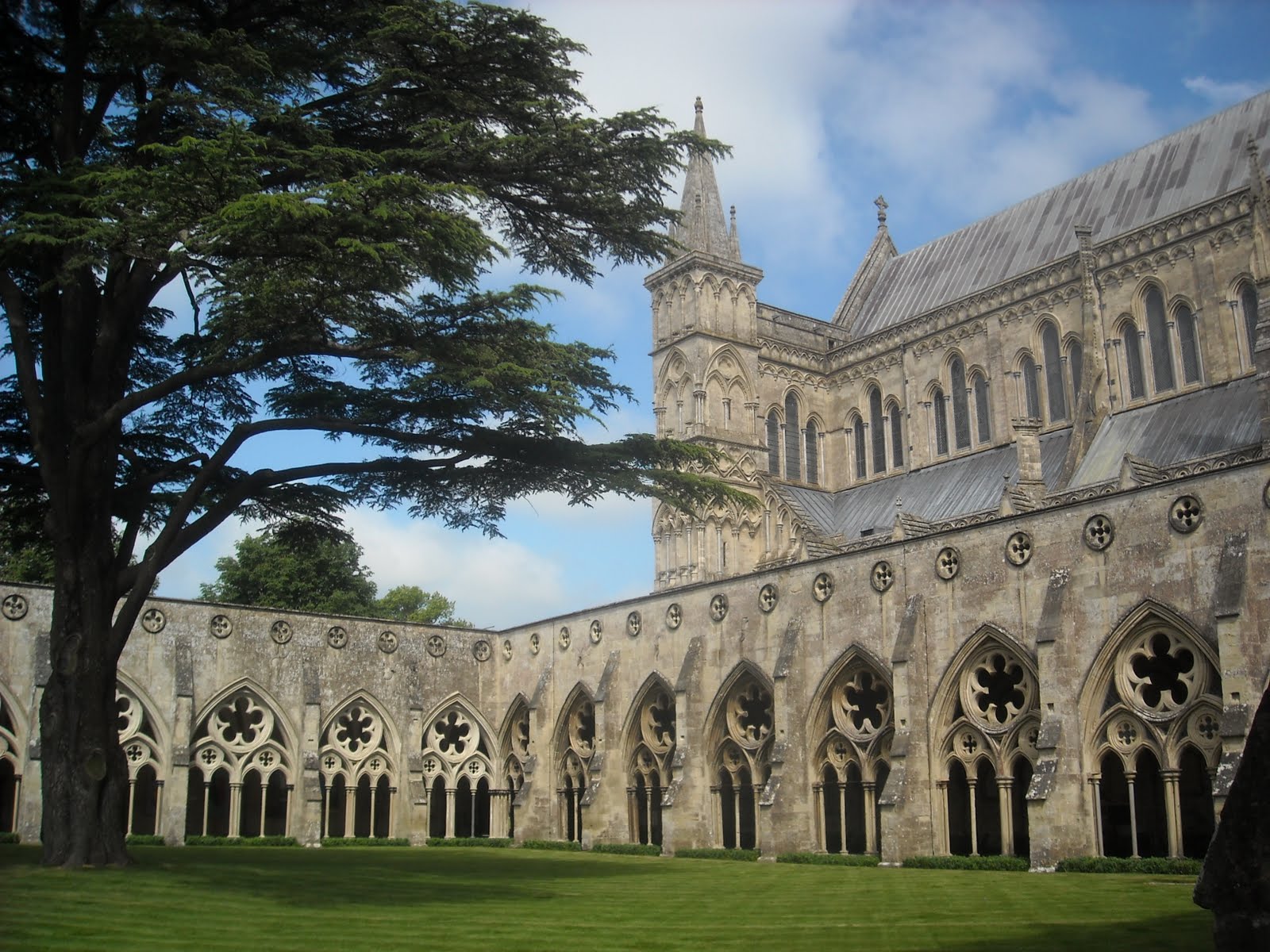
Picture 2: cloisters with Cathedral in background.
Picture 3: rose garden at Mottisfont.
Picture 4: same.
Picture 5: royal palace ruins at Old Sarum.
Picture 6: Stonehenge.
Picture 7: Mom.
Today we toured Salisbury Cathedral, the gardens and house at Mottisfont (estate out in the country between Winchester and Salisbury), the ruins of the castle and cathedral at Old Sarum, and Stonehenge. Really quite a full day. Mom and I both brought plenty of books on this trip, assuming that we'd have some down-time each evening to relax...not so! We keep getting back to our B&B around 9 or 9:30, and then it's only 2 or 2.5 hours before bed.
Anyway, we started the day by finishing Salisbury. We'd gone downtown and wandered around, taking outside pictures of the Cathedral and getting a feel for the city last night, so this morning we made a beeline for the visitors' entrance. The Cathedral itself was pretty similar to the other cathedrals I've seen but unique in its incorporation of more modern art pieces and its incorporation of the modern life of the church into the exhibit. There were a few beautiful modern sculptures scattered in the space and, while modern church activity wasn't exactly made obvious, it was clear that the cathedral is still very much in use and well loved as a spiritual space. It gave it a warmth that I haven't experienced in other cathedrals. Of course, it helped that the sun came out while we were in the Cathedral and lit it up magnificently - when we saw Winchester Cathedral the other day it was chilly and grey, and all the cathedrals I saw on the Continent were toured during the winter... The real highlight of the Cathedral for me were the modern art pieces having to do Prisoners of Conscience and other peace memorials (a beautiful scultpure called "The Thornflower" and a stained glass window) and one of only 4 remaining copies of the original Magna Carta that's on display there. Seeing the MC was pretty cool.
So after the Cathedral, Mom and I booked it back to the B&B, got our car, and drove to Mottisfont. This wasn't on our original itinerary but Mom and I added it after a chance comment by a National Trust employee at Sissinghurst, who mentioned in passing that Mottisfont is home to an immense and famous collection of antique rose varieties, and is well-known for its rose gardens. We certainly weren't disappointed. The rose gardens were unbelievable - I took far too many pictures.
Then on to Old Sarum and Stonehenge. We were expecting Old Sarum to be a quick jump-out-of-the-car-look-at-a-couple-brick-lines-in-the-ground-and go stop, but we ended up staying over an hour. The complex itself was much larger than we imagined with the castle situated on top of a huge hill. And there were more walls of various structures (mainly the king's palace and the great tower) visible and above ground. The cathedral was really just lines in the ground. Mom and I are still confused about why the Bishops built a new cathedral at Salisbury when they had a perfectly good one at Old Sarum just two miles away. One of the plaques at Old Sarum implied that it was because of the tensions between church and state that arose in the 1200s-ish. The Bishops apparently left Old Sarum because they wanted to be separate from the king, which I guess makes sense. But still, what a waste of a perfectly good cathedral and what an expenditure to get a new one!
Stonehenge, of course, was unbelievable. And again, I took far too many pictures. I kept trying to get new angles, etc. We got lucky and the sun came out soon after we got there so about half of my pictures are pretty good. Then the sun disappeared again, and the other half are pretty dark and horrible. Still, that was pretty awesome.
And now we're back in the Wyndham Park Lodge (which we love) for the second night. Tomorrow we'll tour Stourhead and Longleat, then on to Bath!
Thursday, June 10, 2010


Picture 1: house where Jane Austen died in Winchester, July 1817.
Picture 2: ruins of Wolvesey Castle.
Picture 3: view of Winchester from the top of St. Giles' Hill (unfortunately it was a very grey day).
Picture 4: interior of Winchester Cathedral, showing Quire in foreground.
Picture 5: row of icons behind the altar, etc.
Picture 6: Mom in a red telephone booth on the Chorister's Green in Salisbury.
Picture 7: sculpture in front of Salisbury Cathedral called "Walking Madonna," made in 1981.
Today was a long day! Up early for a delicious breakfast with a nice Australian couple also staying at the B&B who are on a 5 WEEK EUROPEAN TOUR. Part of me is jealous but part of me knows that I would get very tired of having structured, planned days one after the other for that long.
We finished up Winchester today, walking by the house on College Street where Jane Austen and her sister, Cassandra, lived for 2 months before Jane died in 1817. Then we spent some time exploring the ruins of Wolvesey Castle. I had no idea that Winchester was so important for a large part of England's history but it apparently had 3 castles during the medieval period in addition to the huge Cathedral! Then a climb up St. Giles' Hill for a view of the city and a thorough walkthrough of the Cathedral. There's currently a nice Jane Austen exhibit around her grave in the Cathedral giving a nice outline of her life, and of course there's the grave itself and a bronze memorial window in the wall. Ah, and the illuminated Bible upstairs in the Cathedral was magnificent - such painstaking work! Oh, I forgot to mention that we went through the City Museum before going into the Cathedral which proved to be an excellent rundown on most of the history of the city (we missed the Tudor and Stuart periods which are housed in Westgate a few blocks north).
Ack, and I also forgot to mention our visit to the Winchester Friends Meeting as we walked through the city after coming down from St. Giles' Hill! Mom and I were just walking along and happened to see a small sign pointing off down a sidestreet that said "Quakers' Meeting House." Interest piqued, we followed and found a rather large Meetinghouse set in a beautiful garden. Not really expecting anyone to be there in the middle of the day on a Thursday, we tried the garden gate and found it open...tried the front door and found it open. We signed the Visitors' Book in the vestibule and then heard a sound of movement in a nearby room. Mom knocked and we surprised the Warden (Resident Friend) who welcomed us in for tea - apparently she has only been in that position for 2 months and we were her first off-the-cuff visitors. We also met the gardener and she gave us some great tips for things to do in Winchester and Salisbury, none of which we have time for. :) We talked with the Warden for a little bit about programs at the Meeting, and it's much more community-involved than our Meeting in Annapolis. Inspiring and definitely something for me to think about as I consider becoming involved in the more urban Friends Meeting of Washington this year.
After Winchester we traveled a bit northwest to Chawton and Jane Austen's house. It was so fun to see where she lived and see all of her furniture, jewelry, dishes, etc.! We spent a good amount of time there because of course we had to read every single plaque and label. After Chawton, we drove to Salisbury, checked into our B&B here, and walked around the Cathedral and downtown briefly before finding a pub for dinner. So we are right on schedule and quite glad to spend two nights in a row in one place!
Wednesday, June 9, 2010
Knole, Wisley, and arrival in Winchester


Picture 1: rock garden at Wisley, with a little bit of alpine meadow in the background
Picture 2: terraced rock garden
Picture 3: Country Garden
Picture 4: white flower, Mixed Borders garden
Picture 5: inside of a poppy, Country Garden
Picture 6: Mom and me in the Rose Garden
Picture 7: Archbishop's Palace section of house at Knole
Picture 8: fossil of extinct prehistoric deer-ish thing
Picture 9: purple roses in the Rose Garden at Wisley
Picture 10: Winchester Cathedral with a monument in front to Hampshire soldiers who died in WWI and WWII
After a delicious breakfast of perfect poached eggs, roasted tomatos, and thick bacon, Mom and I made our way out of Tunbridge Wells and up to Knole. Since we'd done Sissinghurst (the first item on our original itinerary) yesterday, we had a morning slot to fill! Knole is a deer park, garden, and fantastic manor house in Kent, just outside of the M25 London ring road. We only drove through the park on our way to the house but it was beautiful, lightly wooded, rolling, and filled with wandering spotted deer. The drive up to the house had numerous signs warning visitors not to feed or pet the deer for health reasons and of course we saw someone right in front of the door to the house doing both. The house itself was dim and dark (all that Jacobean wood paneling) and unbelievably majestic. We saw a number of galleries and bedrooms, all home to an outstanding, world-famous, collection of Stuart furniture. In one carefully climate-controlled exhibit, a few of the best pieces were kept including a tapestried chair that had been partially restored with some undamaged fabric found under the seat cushion. The vibrancy of the original colors was amazing and let us imagine how beautiful all of the drab and worn furniture was about 350 years ago! We weren't allowed to take pictures, of course, but house was simply stunning.
After Knole, Mom learned how to drive on British roads without a hitch and we made our way west to Wisley Gardens, a huge complex supported by the Royal Horticultural Society. It was located just a few miles south of the ring road towards the southwest side of London...I hope that makes sense. The Wisley complex includes many different themed gardens, an arboretum, a huge glasshouse, an orchard, model gardens, a pine forest, a heather meadow, and probably a few more things that I'm not remembering at the moment. We had nowhere near enough time to see it all (only about 2 hours) but managed to see a fair bit. Earlier we discussed the possibility of going back at the end of our trip, but I won't be surprised if we find our day filled jam-packed with new places. My pictures don't really do Wisley justice, but the garden and flower pictures above are from there and I have MANY more.
After Wisley we made our way a bit further west on the ring road and then turned south on the M3 toward Winchester. We're staying tonight in a B&B called St. Margaret's just a few blocks from the Winchester Cathedral. The owner has two beautiful cats, one of whom recently had 4 adorable black kittens! We spent some time this evening in the kitchen playing with them, complimenting the mama cat, and reassuring the 17-year old calico Rosie that she was a beautiful, sweet kitty and of course appreciated just as much as those hyperactive kittens. We did a quick walk of the the downtown area before dinner, walking around the Cathedral and seeing the remains of one of the old medieval castles. Tomorrow morning we'll see more of Winchester before we head on our way.
Tuesday, June 8, 2010
London to Kent


Picture 1: the Sissinghurst towers, the only bit remaining of the back part of the manor house, which would have stretched to either side of the towers and back behind them, forming a square where the towers were the entrance.
Picture 2: the White Garden.
Picture 3: making friends in the White Garden.
Picture 4: a view of the Rose Garden from one of its entrances.
Picture 5: a view of part of the Rose Garden from the top of the towers.
Picture 6: an iris, I think in the Rose Garden.
Just a few pictures from Sissinghurst today since we're exhausted and jet-lagged. As we chatted about our plans for today while sitting out our layover in Geneva this morning, we discovered in the guidebook that Sissinghurst is open 6 days a week AND NOT WEDNESDAY, the day we were planning on visiting. Our only chance of seeing Sissinghurst, since we have to depart for Winchester tomorrow and won't be back in Kent, was to hope that all would go smoothly with the flight to London, getting through customs, getting the rental car, and driving out of London and into the countryside...smoothly enough that we could get to Sissinghurst around 4 or so with a good two hours before closing. Of course, banking on all of that usually wouldn't work but we got really lucky. Our plane, an almost empty flight, landed in London a good 15 minutes early and Customs were a breeze. We talked with the rental car people for awhile to make sure we understand all the terms exactly, but were still on the road by about 2:30 (with me driving!). Ok, I'll admit that maybe we were on the road at 2:15 but we did several loops around the arrivals area because we couldn't find the turn we wanted, which ended up being the most obvious and sensical one. I'll also admit that there were a few roundabouts during the course of today's driving that got 2 or 3 times around as we figured out the darn English road signs - quite confusing sometimes.
We got to Sissinghurst in good time without getting lost and with no mishaps! Safely on the left side of the road the whole way! The gardens were, of course, beautiful. Mom's favorite was the rose garden. She says she's been liking roses more lately. My favorites were the cottage garden (mostly red, yellow, and orange flowers) and the herb garden (such good smells and potential deliciousness!).
Saturday, June 5, 2010
I found my passport, and that's really all I need!
I thought I'd briefly revive this blog so I can document mom's and my trip to England! Typing is certainly much faster than writing by hand, and as Grandma pointed out, having a record of what we do when will be nice when we look back on this trip in a few years. And hopefully will be a help when we plan future trips! Of course, I'm not sure how often we'll have internet access so posts might be sporadic and not useful as a daily record. I guess we'll see.
Tomorrow is mom's big trip prep day. As for me, I've found my passport! And basically that means that I'm all set. From here, it's maybe an hour of picking out clothes and fitting them and a book or three into my carry-on bag. The only difficult thing will be limiting the amount of books I bring - tomorrow I'm headed to the FREE book warehouse in Baltimore with a couple of friends, and I know I'll come away with a big box full!
Tomorrow is mom's big trip prep day. As for me, I've found my passport! And basically that means that I'm all set. From here, it's maybe an hour of picking out clothes and fitting them and a book or three into my carry-on bag. The only difficult thing will be limiting the amount of books I bring - tomorrow I'm headed to the FREE book warehouse in Baltimore with a couple of friends, and I know I'll come away with a big box full!
Thursday, May 28, 2009
Finals finals finals
The students who did this program in Krakow last year weren't kidding when they told us that all of our work would pile up at the end of the semester!!! I've got to buckle down for the next week and half and tackle my mountain of schoolwork, but when I come out at the other end I'll be taking off for two weeks or so of travel and then back to the States! So I'm currently sitting in my favorite cafe, Les Coleurs on the main market square in Kazimierz, enjoying a near-constant supply of coffee and little sugary cookie-wafers while I do my schoolwork using their wonderfully free wireless internet!
The end of the parents visit went well. We got back from the mountains a day earlier than expected (long story there involving good ol' Polish organization and our professors' failure to realize that Brad, Rachel, and I DID need to go to class on Monday) and Mom and Dad settled back into a hotel room in my building. Monday morning we headed into the center city and Mom and I did some souvenir/gift shopping in the stalls in the Sukiennice, a super old building that's been around since the middle ages and used to be the cloth merchants' hall. Dad found a good seat on the base of Adam Mickiewicz's (famous Polish poet) monument in the main square and buried himself in Michener's Poland. I had to go to class at 12:30 and left them eating their lunches (delicious kebab) in the Planty (the park that encircles the old city and was the defensive moat in the middle ages). I'm not entirely sure what they did while I was in class. I think some wandering around the Planty/outskirts of the old city looking at the monuments and buildings that are highlighted in my Krakow guidebook. We met up after class to catch a tour bus to the Wieliczka salt mine, which I saw in February and thought was a must-see for the parents. They enjoyed it, although Mom got huffy about our tour guide's misrepresentation of Copernicus' contribution to science. The tour guide said that he proved that the sun is the center of the solar system, but as Mom proceeded to explain (at great length) over dinner later, Copernicus only developed a good (not perfectly accurate) model that didn't prove anything. The equipment/knowledge, etc. required to actually prove the heliocentric model wasn't developed until much later. I like having brilliant, nerdy parents, although it does mean that I'm subjected to lectures over dinner. :)
Tuesday was another good day. Mom and Dad were on their own for a lot of it, since I did some homework in the morning and they went to Wawel to see the royal aparments, tickets to which had been sold out when they were at Wawel last week. I had class in the middle of the day while they tried to see the archeological museum...it has a fantastic exhibit on the people who lived in the Krakow area during prehistorical periods. But that museum has the weirdest hours and is only open until 2 on most days so they missed it! After my class and their tour of Wawel, we met in the Planty and went Kopiec Kosciuszko, Kosciuszko's mound. It's a mound of dirt constructed in the 1800s on a hill a little bit to the southwest of the city center to commemorate Kosciuszko for leading the 1794 uprisings against the major powers of Europe. Unfortunately, Kosciuszko's uprising failed and Poland ceased to exist on the maps of Europe in 1795 when it was divided by Prussia, Austria, and Russia, only appearing again after World War I. The mound incorporates dirt from every battlefield where he fought. The mound itself is a well-developed tourist destination with a restaurant and hotel built into the fortifications that the Austrians constructed around it when they had control of Krakow. The main reason for going is the view from the top of the mound, which is a gorgeous panorama of Krakow. We could pick out the main downtown markers: Wawel castle, Kosciol Mariacki on the main market square, the church of Sts. Peter and Paul on Grodzka Street which runs south from the main square to the castle. We could also see my dorm and it was fun to trace out my walking-route to various destinations. It also gave Mom and Dad a great idea of the layout of the city. Oh, and it was cool to see Nova Huta (the giant steelworks that were a huge Communist project in the middle of the 20th century) although it was pretty obscured by smog. I'd learned about Krakow's air being incredibly polluted by industry under Communist rule, but hadn't noticed it on day-to-day basis until I was that high up above the city...it didn't seem to bad, though and is certainly MUCH better than it used to be! Oh, the one other thing that struck me was how green the city is. Again, I'd always heard that Krakow is the greenest city in eastern Europe and one of the greenest in all of Europe, but didn't fully realize what that meant until I was that high. It really looked to me more like a city growing in a forest than trees growing in a city. Yay!
We really didn't have long at the mound, only about a half hour, and then we dashed back to the main square to make a 7 pm Chopin concert in one of the palaces fronting the square. The pianist was a Japanese grad school student studying piano in Krakow and played beautifully. I always forget how difficult Chopin is but when I see it performed I remember how impossible it is! Her performance was incredible. After the concert we ate dinner at a restaurant called Babcia Malina which serves great traditional Polish food.
Wednesday morning was departure morning for Mom and Dad, so we all got up early and went to the airport. I loaded them down with an extra bag that they checked for me, since I'll be going home with much more than I came with!
So it was great to have them here, as I told Dad in an email today...a little taste of home in Krakow.
Now I should probably get back to my schoolwork! Rachel just joined me in the cafe and we're going to reciprocally and strictly enforce study-discipline.
The end of the parents visit went well. We got back from the mountains a day earlier than expected (long story there involving good ol' Polish organization and our professors' failure to realize that Brad, Rachel, and I DID need to go to class on Monday) and Mom and Dad settled back into a hotel room in my building. Monday morning we headed into the center city and Mom and I did some souvenir/gift shopping in the stalls in the Sukiennice, a super old building that's been around since the middle ages and used to be the cloth merchants' hall. Dad found a good seat on the base of Adam Mickiewicz's (famous Polish poet) monument in the main square and buried himself in Michener's Poland. I had to go to class at 12:30 and left them eating their lunches (delicious kebab) in the Planty (the park that encircles the old city and was the defensive moat in the middle ages). I'm not entirely sure what they did while I was in class. I think some wandering around the Planty/outskirts of the old city looking at the monuments and buildings that are highlighted in my Krakow guidebook. We met up after class to catch a tour bus to the Wieliczka salt mine, which I saw in February and thought was a must-see for the parents. They enjoyed it, although Mom got huffy about our tour guide's misrepresentation of Copernicus' contribution to science. The tour guide said that he proved that the sun is the center of the solar system, but as Mom proceeded to explain (at great length) over dinner later, Copernicus only developed a good (not perfectly accurate) model that didn't prove anything. The equipment/knowledge, etc. required to actually prove the heliocentric model wasn't developed until much later. I like having brilliant, nerdy parents, although it does mean that I'm subjected to lectures over dinner. :)
Tuesday was another good day. Mom and Dad were on their own for a lot of it, since I did some homework in the morning and they went to Wawel to see the royal aparments, tickets to which had been sold out when they were at Wawel last week. I had class in the middle of the day while they tried to see the archeological museum...it has a fantastic exhibit on the people who lived in the Krakow area during prehistorical periods. But that museum has the weirdest hours and is only open until 2 on most days so they missed it! After my class and their tour of Wawel, we met in the Planty and went Kopiec Kosciuszko, Kosciuszko's mound. It's a mound of dirt constructed in the 1800s on a hill a little bit to the southwest of the city center to commemorate Kosciuszko for leading the 1794 uprisings against the major powers of Europe. Unfortunately, Kosciuszko's uprising failed and Poland ceased to exist on the maps of Europe in 1795 when it was divided by Prussia, Austria, and Russia, only appearing again after World War I. The mound incorporates dirt from every battlefield where he fought. The mound itself is a well-developed tourist destination with a restaurant and hotel built into the fortifications that the Austrians constructed around it when they had control of Krakow. The main reason for going is the view from the top of the mound, which is a gorgeous panorama of Krakow. We could pick out the main downtown markers: Wawel castle, Kosciol Mariacki on the main market square, the church of Sts. Peter and Paul on Grodzka Street which runs south from the main square to the castle. We could also see my dorm and it was fun to trace out my walking-route to various destinations. It also gave Mom and Dad a great idea of the layout of the city. Oh, and it was cool to see Nova Huta (the giant steelworks that were a huge Communist project in the middle of the 20th century) although it was pretty obscured by smog. I'd learned about Krakow's air being incredibly polluted by industry under Communist rule, but hadn't noticed it on day-to-day basis until I was that high up above the city...it didn't seem to bad, though and is certainly MUCH better than it used to be! Oh, the one other thing that struck me was how green the city is. Again, I'd always heard that Krakow is the greenest city in eastern Europe and one of the greenest in all of Europe, but didn't fully realize what that meant until I was that high. It really looked to me more like a city growing in a forest than trees growing in a city. Yay!
We really didn't have long at the mound, only about a half hour, and then we dashed back to the main square to make a 7 pm Chopin concert in one of the palaces fronting the square. The pianist was a Japanese grad school student studying piano in Krakow and played beautifully. I always forget how difficult Chopin is but when I see it performed I remember how impossible it is! Her performance was incredible. After the concert we ate dinner at a restaurant called Babcia Malina which serves great traditional Polish food.
Wednesday morning was departure morning for Mom and Dad, so we all got up early and went to the airport. I loaded them down with an extra bag that they checked for me, since I'll be going home with much more than I came with!
So it was great to have them here, as I told Dad in an email today...a little taste of home in Krakow.
Now I should probably get back to my schoolwork! Rachel just joined me in the cafe and we're going to reciprocally and strictly enforce study-discipline.
Monday, May 25, 2009
Rodzice w Krakowie (that might mean "parents in Krakow!")
The parental visit is going really well, minus some inconveniences related to the weekend we just spent at a mountain lodge in the Tatra Mountains... Fun weekend that involved a bit more walking than we'd originally been told and no private bathroom in each room (Mom's pet peeve). We did all enjoy the mountain atmosphere, though, and went on a lovely hike on Saturday! Mom, Dad and Professor McGarity ( the Swarthmore professor who runs the program) turned back after 4.5 km or so and a long mountain climb to spend a relaxing afternoon in the lodge. The kids and our Politechnika professor from Krakow proceeded on for a total of 22-ish km along a beautiful ridge and a strenuous climb to a real PEAK. Fantastic.
Other than our 2 days in the mountains, Mom and Dad have been doing all the tourist-y things in Krakow. A few museums, the royal castle (Wawel), walks around various parts of the city to admire the architecture, and today a trip to the huge salt mine in Wieliczka.
Oops, these pictures are in backwards order...
Professor McGarity and Dad playing radio.
The Group! Dad, Mom, Professor McGarity in the black hat and Professor Dabrowski from Politechnika in the tan hat and white shirt. And the back of Brad's head in the right side of the picture.
Dad and an energy advertisement in the main market square. There are all sorts of billboards up that have to do with the upcoming election for EU parliament. This one basically said "where do you want your energy coming from? VOTE"

Pigeon with a ring of bread around its neck that I saw in Kazimierz.
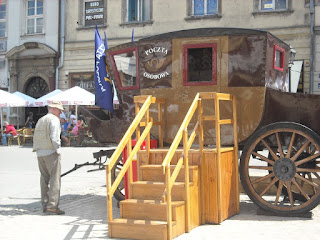
Dad and an old-fashioned post carriage in the main market square. I think they were selling postcards or something inside.
Other than our 2 days in the mountains, Mom and Dad have been doing all the tourist-y things in Krakow. A few museums, the royal castle (Wawel), walks around various parts of the city to admire the architecture, and today a trip to the huge salt mine in Wieliczka.
Oops, these pictures are in backwards order...

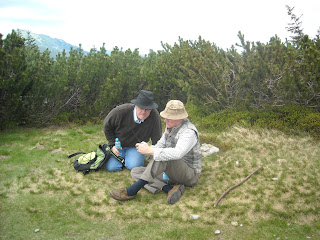
Professor McGarity and Dad playing radio.

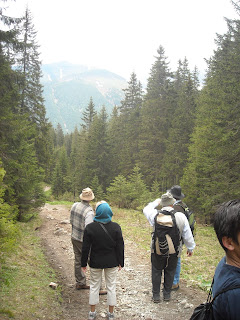
The Group! Dad, Mom, Professor McGarity in the black hat and Professor Dabrowski from Politechnika in the tan hat and white shirt. And the back of Brad's head in the right side of the picture.

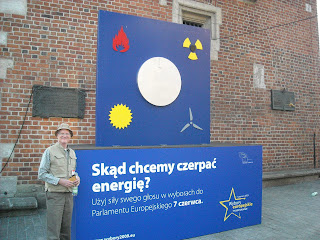
Dad and an energy advertisement in the main market square. There are all sorts of billboards up that have to do with the upcoming election for EU parliament. This one basically said "where do you want your energy coming from? VOTE"

Pigeon with a ring of bread around its neck that I saw in Kazimierz.

Dad and an old-fashioned post carriage in the main market square. I think they were selling postcards or something inside.
Thursday, May 21, 2009
Procrastination!
I thought I'd hop on here for a brief post as I take a break from finishing up a paper due tomorrow...
Mom and Dad arrived Tuesday evening for their week-long visit here! I picked them up at the airport and we took a taxi into the old city for a stop at the 24-hour pierogi restaurant on Sławkowska street. On Wednesday they went to an art/Polish history museum (the Czartoryski) and had some time to explore the old city on their own while I was in class. We decided to go to a tiny chamber music concert in one of the churches in the main square on the spur of the moment. Fantastic concert and in the cutest Catholic church I've ever seen. It's absolutely minuscule but of course sumptuously decorated.
Friday, May 15, 2009
Continuing with the Czech Republic...
Sunday morning (May 3rd) we woke up in Slavicin, which is in the southeastern part of the country. We spent the morning at Hostetin, a teeny tiny village of 280-ish people that's been basically taken over by a Brno-based environmental NGO called Veronika. The NGO helped the village fund the installation of a reed-bed wastewater treatment system - so amazing to see after learning about similar treatment methods in our ecological engineering course! The basic idea is to use natural processes in the secondary stage of wastewater treatment although the wastewater undergoes a typical primary stage. The advantage is that virtually no energy is used in the wastewater treatment process since the primary stage is usually mechanical - sieves, screening, etc. Our guide from the NGO said that the electrical costs of the mechanical treatment are about USD 10 per year, and they have to pay someone to come 4 times per year for an hour or two each time to make sure that the reed-bed is healthy. The reed-bed is basically a wetland, so the community also gets the aesthetic benefit of a 25 foot by 25 foot wetland. Oh, and I should add that all of the wastewater is underground and accessible by the roots of the plants. Our guide invited us to walk through the wetland. :) Totally cool!
The NGO also runs a small organic juice production facility in the village which produces the most delicious apple juice I've ever tasted. We got to try their plain apple juice, apple-beetroot, apple-mate, and apple-mint. All good, although the plain apple was my favorite followed by the surprisingly good apple-beetroot. The buildings constructed by the NGO (juice buildings, educational and hotel complex) are passive buildings. I'm not sure entirely what that means but they're really environmentally-friendly and efficient. The village also has a biomass incinerator that burns waste wood chips from the logging industry situated in the nearby moutains and and seed and pit husks from the slivovice (Czech brandy made from fruit seeds, etc.) production industry. Most of the heat energy consumed by the village during the winter is produced from this incinerator (so no fossil fuels used) and they turn it off in the summer when no one needs heat. Residents use electricity for hot water in the summer. I'm a little skeptical of how "green" biomass incineration is, though, since yes, you're recycling waste but you're still also releasing carbon dioxide and other polluting compounds to the atmosphere. I will agree that it's better than using nonrenewable fossil fuels, though.
After grabbing lunch, our luggage from the hotel in Slavicin, and a huge box of traditional Czech baked goods, we hopped on a train to Brno, the second largest city in the Czech Republic. The train station in Slavicin was awesome - one tiny building next to the tracks in the middle of some crop fields. Nothing beats an afternoon in a warm, sun-filled train car with a box of chocolatey, sugary goodies - it reminded me of Harry Potter. We arrived in Brno by 7 pm and Zbynek took us to our hotel and oriented us on the city map before giong home to his family. We wandered around the city a little bit (the downtown is tiny!) and found a delicious dinner. Pork loin and veggies for me.
Monday morning (May 8th) we met Zbynek at his office in the Department of Environmental Studies at Masaryj University. We spent the morning basically learning about the program there and some of the projects the PhD students are working on, and then went for lunch at a delicious vegetarian restaurant. Rachel's a vegetarian and had been craving something a bit lighter than all the heavy Czech potatoes available in the countryside. After lunch, we spent the afternoon at an NGO (the Czech name is long and confusing) learning about their projects throughout the country. We had a little bit of time in the afternoon to wander around the city and do some sightseeing. Our first stop was a crypt in the old Capuchin monastery where the air conditions in the crypt over the centuries had mummified the bodies of the monks buried there. The museum display just had all the dead bodies out and visible, since the monks had been "buried" simply by laying them on the ground in the tombs and leaving them there. It was really creepy, but kind of cool. Our next stop was the main cathedral - beautiful! We climbed to the top of one of the belltowers to get a view of the city. Our final stop was a quick walk around the castle, although unfortunately we missed the closing time for the museums. We ate dinner at a great restaurant. The Czech name translated to "Green Cat!"
That's it for now. We're leaving soon for a weekend in the Pieniny mountains south of Krakow but not as south as the Tatra/Carpathian mountains. We're supposed to do some river-rafting tomorrow and some mountain biking on Sunday, weather permitting...the forecast calls for some drizzles on both days.
Sunday morning (May 3rd) we woke up in Slavicin, which is in the southeastern part of the country. We spent the morning at Hostetin, a teeny tiny village of 280-ish people that's been basically taken over by a Brno-based environmental NGO called Veronika. The NGO helped the village fund the installation of a reed-bed wastewater treatment system - so amazing to see after learning about similar treatment methods in our ecological engineering course! The basic idea is to use natural processes in the secondary stage of wastewater treatment although the wastewater undergoes a typical primary stage. The advantage is that virtually no energy is used in the wastewater treatment process since the primary stage is usually mechanical - sieves, screening, etc. Our guide from the NGO said that the electrical costs of the mechanical treatment are about USD 10 per year, and they have to pay someone to come 4 times per year for an hour or two each time to make sure that the reed-bed is healthy. The reed-bed is basically a wetland, so the community also gets the aesthetic benefit of a 25 foot by 25 foot wetland. Oh, and I should add that all of the wastewater is underground and accessible by the roots of the plants. Our guide invited us to walk through the wetland. :) Totally cool!
The NGO also runs a small organic juice production facility in the village which produces the most delicious apple juice I've ever tasted. We got to try their plain apple juice, apple-beetroot, apple-mate, and apple-mint. All good, although the plain apple was my favorite followed by the surprisingly good apple-beetroot. The buildings constructed by the NGO (juice buildings, educational and hotel complex) are passive buildings. I'm not sure entirely what that means but they're really environmentally-friendly and efficient. The village also has a biomass incinerator that burns waste wood chips from the logging industry situated in the nearby moutains and and seed and pit husks from the slivovice (Czech brandy made from fruit seeds, etc.) production industry. Most of the heat energy consumed by the village during the winter is produced from this incinerator (so no fossil fuels used) and they turn it off in the summer when no one needs heat. Residents use electricity for hot water in the summer. I'm a little skeptical of how "green" biomass incineration is, though, since yes, you're recycling waste but you're still also releasing carbon dioxide and other polluting compounds to the atmosphere. I will agree that it's better than using nonrenewable fossil fuels, though.
After grabbing lunch, our luggage from the hotel in Slavicin, and a huge box of traditional Czech baked goods, we hopped on a train to Brno, the second largest city in the Czech Republic. The train station in Slavicin was awesome - one tiny building next to the tracks in the middle of some crop fields. Nothing beats an afternoon in a warm, sun-filled train car with a box of chocolatey, sugary goodies - it reminded me of Harry Potter. We arrived in Brno by 7 pm and Zbynek took us to our hotel and oriented us on the city map before giong home to his family. We wandered around the city a little bit (the downtown is tiny!) and found a delicious dinner. Pork loin and veggies for me.
Monday morning (May 8th) we met Zbynek at his office in the Department of Environmental Studies at Masaryj University. We spent the morning basically learning about the program there and some of the projects the PhD students are working on, and then went for lunch at a delicious vegetarian restaurant. Rachel's a vegetarian and had been craving something a bit lighter than all the heavy Czech potatoes available in the countryside. After lunch, we spent the afternoon at an NGO (the Czech name is long and confusing) learning about their projects throughout the country. We had a little bit of time in the afternoon to wander around the city and do some sightseeing. Our first stop was a crypt in the old Capuchin monastery where the air conditions in the crypt over the centuries had mummified the bodies of the monks buried there. The museum display just had all the dead bodies out and visible, since the monks had been "buried" simply by laying them on the ground in the tombs and leaving them there. It was really creepy, but kind of cool. Our next stop was the main cathedral - beautiful! We climbed to the top of one of the belltowers to get a view of the city. Our final stop was a quick walk around the castle, although unfortunately we missed the closing time for the museums. We ate dinner at a great restaurant. The Czech name translated to "Green Cat!"
That's it for now. We're leaving soon for a weekend in the Pieniny mountains south of Krakow but not as south as the Tatra/Carpathian mountains. We're supposed to do some river-rafting tomorrow and some mountain biking on Sunday, weather permitting...the forecast calls for some drizzles on both days.
Monday, May 11, 2009
So I guess I'll try to write a little about my trip to the Czech Republic, although I've missed a lot of important things from before then as well such as Innsbruck, Venice, and life in Krakow. Oops!
We caught a 6:50 AM (absurdly early) train on May 1st for the Czech Republic, and slept for the three hour ride until we arrived in Ostrava, the third largest city in the country and pretty close to the border with Poland. We had a bit of a panic when we got to Ostrava because I remembered from trips through the city on my way to and from Vienna that there are two train stations and we weren't sure if we were at the correct one. We tried asking a conductor on the platform after jumping off the train but he didn't know English or Polish (that was odd). Luckily though, a pretty sketchy-looking man approached us as we spoke with the conductor and turned out to be our guide in the Czech Republic! His name is Zbynek Ulćak, a professor of Environmental Studies at Masaryk University in Brno. We only saw him wear two shirts for the entire 6 days that we were with him - a blue/gray one that he would wear during the day and a forest green one in the evening when we would go to restaurants for dinner. Zbynek turned out to be one of the coolest men I've ever met. He knows absolutely everything there is to know about anything and turned out to be really personable and fun to spend time with.
Our first day we spent in Ostrava. In the morning we were at an old coal mine that had closed in 1991 and been turned into a museum/tourist attraction in '93. Our tour guide of the museum and mine was a guy named Daniel who was dressed kind of like a cowboy. He didn't have a hat, but he had the denim, the belt with a huge buckle, the leather boots, etc. The museum was located in the old miners' guild hall and had really nice exhibits with old machinery from the mines and some pretty cool models of machinery that were too large and cumbersome to be brought back aboveground. The tour of the mine itself was fun although similar to our tour of the Wieliczka salt mine in February. The only difference was that the coal mine still had huge pieces of machinery set up, some of which would even run so that we get some idea of the conditions of working in the mine - it was REALLY noisy!
We ate lunch in the old miner's pub after the tour and had our first taste of Czech food - pork in a delicious creamy sauce with a huge side of potatos. Rachel and I both had lemonade to drink (of course after the local beer, Ostravar) which is always an adventure in Europe since every place somehow interprets the idea differently. This one was a pink grapefruit drink with a hint of lemon and half of full of bits of fruit. Tasty, but not lemonade.
Our afternoon activity in Ostrava was a hike to the top of a huge slag heap a few kilometers from the city center. It's a hill, the highest one around, made of jumbled rock that had been excavated during the coal mining process at a nearby mine. The heap had later been covered with some topsoil and planted trees to make a beautiful green park of sorts, crisscrossed with trails for hiking and mountain-biking. The cool part about the heap is that all of the leftover bits of coal mixed in with the rock that were uneconomical to mine a few decades ago are slowly burning in the middle of the mound, creating places where the ground surface is really hot and steam and other gases are visibly escaping. Zbynek explained why the coal burns even though it's under a huge amount of rock: all of the smaller particles (including coal dust and small bits of coal) end up at the bottom center of the pile with the large rock ends up on the outside of the mound. The spaces between the large rocks allow air to enter the mound and a chimney-effect occurs where air is sucked in at the bottom and flows up and out through the top, providing a constant flow of oxygen that allows combustion. Anyway! There was a beautiful view of the city in all directions from the top of the heap, and the surrounding area was surprisingly almost entirely green. I thought it was great although also a little depressing or empowering when Zbynek informed us that all of the green we could see used to be industrial wasteland that has been since been planted under land reclamation plans. Zbynek kept emphasizing that nature is better at reclaiming landscapes on its own than when we tamper with natural processes, mentioning that reclamation planners often include nonnative species or install weird mixes of soil types that are inefficient for reclamation and more costly.
Our final tour activity of the day was to ride the elevator to the top of the new town tower in order to see the view, which was similar to the view from the slag heap and about as high. We could see Poland, Ostrava, the old and new steelworks, and the main shaft towers for several no-longer-in-use coal mines.
Our second day in the Czech Republic, May 2, also started early with an 8:15 departure from the hotel. Our accommodations on the whole trip were really nice - Rachel and I shared a hotel room, very nice ones, every night, Brad had his own, and Zbynek shared with his brother-in-law, Michal, who was along with us for part of the trip. Anyway, we left on the second morning and drove to a nature preserve located in the White Carpathian mountains and maintained by a small NGO. One of the founders of the NGO took us on a long hike on the lower slopes of the mountains to learn about the composition of the forest and about the logging industry which had decimated it decades ago.
We spent the afternoon at the Valaśske Muzeum v Prirode (there's a carrot symbol on the first r and on the e in the last word, but I don't how to make them on my computer), a museum documenting the rural life of the Wallachian people over the past couple of centuries. They had a reconstructed wooden town, a museum exhibiting crafts and folk art, a museum full of old modes of transportation, and a valley filled with reconstructed water mills of various types: felting, saw, blacksmith, and a non-water-powered oil press. It's really impressive how much people were able to accomplish using essentially just wood.
After the museum we had an hour-long ride to Slavicin and then dinner in a small 18th-century Renaissance-y castle that had replaced an earlier one from the Middle Ages. Rachel and I went to bed really early because of the early start we'd gotten that morning. The bathroom setup in our room was really odd, with the shower bottom about a foot-and-a-half off the ground and the sink located such that half of it was actually inside the shower!
That's it for now, because it's late here and I want to do some reading before class tomorrow. But hopefully I'll get back into the habit of making fairly regular blog updates!
We caught a 6:50 AM (absurdly early) train on May 1st for the Czech Republic, and slept for the three hour ride until we arrived in Ostrava, the third largest city in the country and pretty close to the border with Poland. We had a bit of a panic when we got to Ostrava because I remembered from trips through the city on my way to and from Vienna that there are two train stations and we weren't sure if we were at the correct one. We tried asking a conductor on the platform after jumping off the train but he didn't know English or Polish (that was odd). Luckily though, a pretty sketchy-looking man approached us as we spoke with the conductor and turned out to be our guide in the Czech Republic! His name is Zbynek Ulćak, a professor of Environmental Studies at Masaryk University in Brno. We only saw him wear two shirts for the entire 6 days that we were with him - a blue/gray one that he would wear during the day and a forest green one in the evening when we would go to restaurants for dinner. Zbynek turned out to be one of the coolest men I've ever met. He knows absolutely everything there is to know about anything and turned out to be really personable and fun to spend time with.
Our first day we spent in Ostrava. In the morning we were at an old coal mine that had closed in 1991 and been turned into a museum/tourist attraction in '93. Our tour guide of the museum and mine was a guy named Daniel who was dressed kind of like a cowboy. He didn't have a hat, but he had the denim, the belt with a huge buckle, the leather boots, etc. The museum was located in the old miners' guild hall and had really nice exhibits with old machinery from the mines and some pretty cool models of machinery that were too large and cumbersome to be brought back aboveground. The tour of the mine itself was fun although similar to our tour of the Wieliczka salt mine in February. The only difference was that the coal mine still had huge pieces of machinery set up, some of which would even run so that we get some idea of the conditions of working in the mine - it was REALLY noisy!
We ate lunch in the old miner's pub after the tour and had our first taste of Czech food - pork in a delicious creamy sauce with a huge side of potatos. Rachel and I both had lemonade to drink (of course after the local beer, Ostravar) which is always an adventure in Europe since every place somehow interprets the idea differently. This one was a pink grapefruit drink with a hint of lemon and half of full of bits of fruit. Tasty, but not lemonade.
Our afternoon activity in Ostrava was a hike to the top of a huge slag heap a few kilometers from the city center. It's a hill, the highest one around, made of jumbled rock that had been excavated during the coal mining process at a nearby mine. The heap had later been covered with some topsoil and planted trees to make a beautiful green park of sorts, crisscrossed with trails for hiking and mountain-biking. The cool part about the heap is that all of the leftover bits of coal mixed in with the rock that were uneconomical to mine a few decades ago are slowly burning in the middle of the mound, creating places where the ground surface is really hot and steam and other gases are visibly escaping. Zbynek explained why the coal burns even though it's under a huge amount of rock: all of the smaller particles (including coal dust and small bits of coal) end up at the bottom center of the pile with the large rock ends up on the outside of the mound. The spaces between the large rocks allow air to enter the mound and a chimney-effect occurs where air is sucked in at the bottom and flows up and out through the top, providing a constant flow of oxygen that allows combustion. Anyway! There was a beautiful view of the city in all directions from the top of the heap, and the surrounding area was surprisingly almost entirely green. I thought it was great although also a little depressing or empowering when Zbynek informed us that all of the green we could see used to be industrial wasteland that has been since been planted under land reclamation plans. Zbynek kept emphasizing that nature is better at reclaiming landscapes on its own than when we tamper with natural processes, mentioning that reclamation planners often include nonnative species or install weird mixes of soil types that are inefficient for reclamation and more costly.
Our final tour activity of the day was to ride the elevator to the top of the new town tower in order to see the view, which was similar to the view from the slag heap and about as high. We could see Poland, Ostrava, the old and new steelworks, and the main shaft towers for several no-longer-in-use coal mines.
Our second day in the Czech Republic, May 2, also started early with an 8:15 departure from the hotel. Our accommodations on the whole trip were really nice - Rachel and I shared a hotel room, very nice ones, every night, Brad had his own, and Zbynek shared with his brother-in-law, Michal, who was along with us for part of the trip. Anyway, we left on the second morning and drove to a nature preserve located in the White Carpathian mountains and maintained by a small NGO. One of the founders of the NGO took us on a long hike on the lower slopes of the mountains to learn about the composition of the forest and about the logging industry which had decimated it decades ago.
We spent the afternoon at the Valaśske Muzeum v Prirode (there's a carrot symbol on the first r and on the e in the last word, but I don't how to make them on my computer), a museum documenting the rural life of the Wallachian people over the past couple of centuries. They had a reconstructed wooden town, a museum exhibiting crafts and folk art, a museum full of old modes of transportation, and a valley filled with reconstructed water mills of various types: felting, saw, blacksmith, and a non-water-powered oil press. It's really impressive how much people were able to accomplish using essentially just wood.
After the museum we had an hour-long ride to Slavicin and then dinner in a small 18th-century Renaissance-y castle that had replaced an earlier one from the Middle Ages. Rachel and I went to bed really early because of the early start we'd gotten that morning. The bathroom setup in our room was really odd, with the shower bottom about a foot-and-a-half off the ground and the sink located such that half of it was actually inside the shower!
That's it for now, because it's late here and I want to do some reading before class tomorrow. But hopefully I'll get back into the habit of making fairly regular blog updates!
Thursday, April 23, 2009
I saw a fantastic movie, "Man on Wire," Tuesday evening with Rachel and Alex, one of our British friends. Well-done documentary about Philippe Petit, the Frenchman who walked on a tight-rope (really a steel cable but I don't know what else to call it) stretched between the two towers of the World Trade Center in the 1970s.
Friday, April 17, 2009
Kraków has the best street food in all of Europe.
And I state that emphatically and without qualifications even though I can only compare it with Berlin, Vienna, and Venice. We've got zapiekanki which are basically an open-face 12-inch sub roll covered in grilled mushrooms, melted cheese and ketchup. On the deluxe version you can get any combination of chives, garlic sauce, lettuce, tomato, pickles, corn and variety of meats. Then there are kebabs: a delicious medley of veggies (red cabbage, white cabbage, beats, carrots, pickles, lettuce, tomato, onions), meat, cheese and your choice of the-spicy-sauce-that-WILL-knock-your-socks-off or the-garlic-sauce-that-you-WILL-still-taste-next-morning-no-matter-how-much-gum-you-chew. And obwarzanki, which are apparently a Kraków specialty...they have similar versions in other Polish cities but K is the only place that gets the twist just right. Imagine a bagel with a larger hole in the middle, less dense bread that's twisted nicely, and covered in any one of a variety of toppings: sesame seeds, poppy seeds, roasted cheesy bits, plain, or (my favorite) pikantny! I can't quite figure out what's on the pikantny one, but there are lots of grainy things and it's quite deliciously spicy. Ooh, and now that it's warmer a lot of the street food stands are selling hot, steamy corn-on-the-cob. OH, I almost forgot gofry! Gofry are waffles (in the good places you have to wait a few minutes because they cook the waffles RIGHT THEN) covered with all sorts of yummy tidbits: chocolate sauce, caramel sauce, whipped cream, different types of jams, whole fruits, nutella... Nothing better than being handed a waffle on a paper plate dripping with whipped cream and chocolate sauce. Although there was that one time that I tipped my waffle slightly and all my whipped cream just slid off it since it was so warm and melty, and splatted on the ground. I thought that was only supposed to happen when you were 6 years old.
I read a newspaper today, which is a pretty incredible phenomenon for a couple of reasons. I normally get all of my news from the good old internet from daily emails by the Washington Post and New York Times, and it's a little expensive to obtain English newspapers in Kraków. I sat for a few hours today in Massolit, the English-language bookstore, and read a copy of April 16's International Herald Tribune as a break from my work. I read an interesting article about how the Himalayan glaciers are epxected to lose 75% of their ice by 2020, in the short-term causing severe flooding in mountain communities and in the longer-term causing severe water shortages since many of the major rivers in Asia have their source in those glaciers. This leads to, guess what, "desperate battles over water." Take Pakistan, for instance, whose major rivers all originate in India... It would have been a depressing article to read except for the large number of climate change initiatives listed at the end and a dead-on analysis of what needs to happen in the near future.
I had a wonderful time in Innsbruck and Venice last week, and will put up some pictures and write a little bit about it later this weekend...it's too late now and sleep is calling.
I read a newspaper today, which is a pretty incredible phenomenon for a couple of reasons. I normally get all of my news from the good old internet from daily emails by the Washington Post and New York Times, and it's a little expensive to obtain English newspapers in Kraków. I sat for a few hours today in Massolit, the English-language bookstore, and read a copy of April 16's International Herald Tribune as a break from my work. I read an interesting article about how the Himalayan glaciers are epxected to lose 75% of their ice by 2020, in the short-term causing severe flooding in mountain communities and in the longer-term causing severe water shortages since many of the major rivers in Asia have their source in those glaciers. This leads to, guess what, "desperate battles over water." Take Pakistan, for instance, whose major rivers all originate in India... It would have been a depressing article to read except for the large number of climate change initiatives listed at the end and a dead-on analysis of what needs to happen in the near future.
I had a wonderful time in Innsbruck and Venice last week, and will put up some pictures and write a little bit about it later this weekend...it's too late now and sleep is calling.
Friday, April 3, 2009
Itinerary and Easter Market!
This afternoon I leave on my week+ vacation!
First stop, Vienna to meet up with Chris.
Sat. 4/4: train to Innsbruck
4/4-4/8: explore Innsbruck and surrounds (1 day in city, 2 days hiking?)
4/8: back to Vienna to catch an overnight train to Venice
4/9-4/13: Venice!
4/13: train to Vienna and back to Krakow that night or early morning on the 14th
YES! I'm excited to see all of these new places.
It's going to be hard to get away from Krakow from here on out though, since it's so beautiful in springtime. Yesterday the weather was 60 F in the sunshine, maybe 50 in the shade. Rachel and I walked from Dom Piast to the old city (about a 40 minute walk) to enjoy the sunshine. I treated myself to a two-scoop cone of ice cream at the mall - chocolate and vanilla, I went basic but both flavors are SO rich at this ice cream cafe. Rachel and I hung out with some of our British friends for a little while at an outdoor cafe a few blocks from the main square and then took a short walk through the Easter market set up in the main square before heading home.
We've been watching the process of setting up the market for the past week or so. Every day there was something new - first the stalls, then wicker animals on top of some of them, then colored wicker eggs, then a HUGE barrel for mulled wine, then the larger grill stalls started appearing and a beautiful little garden in the middle of the square! Yesterday was the first day it opened and of course now I'm going away...but we've heard that the Christmas market was in place in the main square for a month so I'm assuming that the Easter market will definitely be around when I get back, only one day after Easter.
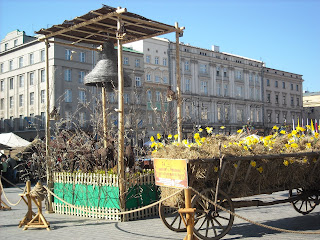
Decoration on one end of the market.
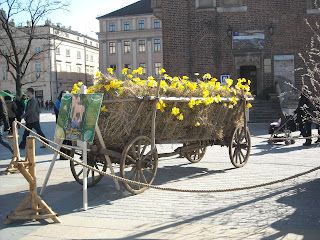
I love this wagon with daffodils coming out of the hay. Pretty and a little goofy with all those little daffodil-heads waving in the breeze.

Awesome wall graffiti that Rachel and I saw on our walk in.
First stop, Vienna to meet up with Chris.
Sat. 4/4: train to Innsbruck
4/4-4/8: explore Innsbruck and surrounds (1 day in city, 2 days hiking?)
4/8: back to Vienna to catch an overnight train to Venice
4/9-4/13: Venice!
4/13: train to Vienna and back to Krakow that night or early morning on the 14th
YES! I'm excited to see all of these new places.
It's going to be hard to get away from Krakow from here on out though, since it's so beautiful in springtime. Yesterday the weather was 60 F in the sunshine, maybe 50 in the shade. Rachel and I walked from Dom Piast to the old city (about a 40 minute walk) to enjoy the sunshine. I treated myself to a two-scoop cone of ice cream at the mall - chocolate and vanilla, I went basic but both flavors are SO rich at this ice cream cafe. Rachel and I hung out with some of our British friends for a little while at an outdoor cafe a few blocks from the main square and then took a short walk through the Easter market set up in the main square before heading home.
We've been watching the process of setting up the market for the past week or so. Every day there was something new - first the stalls, then wicker animals on top of some of them, then colored wicker eggs, then a HUGE barrel for mulled wine, then the larger grill stalls started appearing and a beautiful little garden in the middle of the square! Yesterday was the first day it opened and of course now I'm going away...but we've heard that the Christmas market was in place in the main square for a month so I'm assuming that the Easter market will definitely be around when I get back, only one day after Easter.

Decoration on one end of the market.

I love this wagon with daffodils coming out of the hay. Pretty and a little goofy with all those little daffodil-heads waving in the breeze.

Awesome wall graffiti that Rachel and I saw on our walk in.
Subscribe to:
Posts (Atom)